
top of page

Step Inside the Lesson: How Virtual Reality Is Changing the Way Students Learn

Sep 8
12 min read

From walking through a living cell to conducting a virtual chemistry experiment, VR can turn difficult ideas into experiences students can see, explore, and remember.

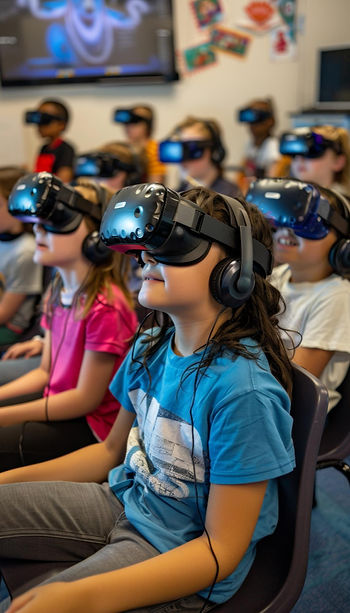
For generations, classrooms have relied on books, lectures, diagrams, videos, and physical experiments to help students understand the world. These methods remain essential, but virtual reality, or VR, adds something different: the ability to place students inside an interactive learning environment.

Instead of simply reading about the structure of a cell, a student can explore a three-dimensional model of one. Instead of looking at a picture of a planetary system, students can examine planets and their relationships in 3D space. A dangerous, expensive, or impractical laboratory procedure can be simulated without exposing students to the same physical hazards as a real experiment.

The technology is more than an attention-grabbing classroom gadget. A growing body of research suggests that well-designed immersive learning can improve aspects of student performance, problem-solving, motivation, engagement, and understanding, particularly when VR requires students to actively interact with what they are learning. However, the research also shows that VR is not automatically better than conventional teaching in every situation.

The real educational value of VR comes from what students are able to do inside the virtual environment.

Learning by Doing Instead of Only Watching

A traditional science lesson might involve a teacher explaining a process while students listen, take notes, examine diagrams, and later answer questions.

VR can add an experiential layer to that lesson.

A student studying anatomy, for example, could examine a three-dimensional organ from different angles. A physics student could manipulate objects and observe forces in action. Engineering students could experiment with designs, identify failures, modify their approach, and try again.

This matters because effective learning often involves more than receiving information. Students need opportunities to manipulate ideas, make decisions, test predictions, recognize mistakes, and connect new information with what they already know.

A 2024 systematic review by Matthias Conrad, David Kablitz, and Stephan Schumann examined 30 studies of immersive VR in education and training. The researchers concluded that immersive VR showed positive educational potential compared with other media, particularly in learning environments built around active engagement and practical application. The authors also found that results varied according to the type of learning activity. In other words, putting on a headset is not enough. How students interact with the lesson matters.

That distinction helps explain both the excitement surrounding educational VR and the mixed results sometimes found in research.

VR Can Strengthen Problem-Solving Skills

One of VR's most promising educational uses is developing problem-solving ability.

Problem solving requires students to do something very different from memorizing a definition. They must recognize a problem, identify relevant information, consider possible solutions, make decisions, observe the consequences, and revise their approach.

Interactive virtual environments are well suited to this process because students can be placed in situations where their choices have visible consequences.

A study published in Interactive Learning Environments in 2024 examined 73 fourth-grade students and 86 eighth-grade students at two schools in northwest China. Researchers compared science instruction using VR headsets with instruction using interactive whiteboards.

The results were particularly interesting because the benefits differed by age. VR improved learning performance among the primary-school students, while the improvement in learning performance was not statistically significant among the secondary students. However, problem-solving ability improved significantly for both primary and secondary students. The VR environment also significantly improved self-efficacy in both age groups.

This is an important reminder not to oversimplify the evidence. VR does not produce identical benefits for every student or every learning outcome. Yet its effects on problem solving can be especially valuable.

Earlier research points in the same direction. Paola Araiza-Alba, Therese Keane, Won Sun Chen, and Jordy Kaufman studied immersive VR as a way of teaching children problem-solving skills. Their work, published in Computers & Education in 2021, concluded that immersive VR can be useful for learning and practicing problem solving. The researchers also reported greater student engagement with immersive VR than with traditional teaching methods.

Another study of elementary science instruction found that integrating spherical-video VR into scientific inquiry activities produced significant effects on both learning outcomes and problem-solving ability. Interestingly, students who began with less positive learning attitudes appeared to benefit particularly strongly from the VR-supported activity.

VR therefore has the potential to turn problem solving from something students answer on paper into something they actually experience.

Immersion Can Turn Passive Lessons Into Active Experiences

Engagement is another major reason educators are interested in VR.

Students can become distracted during any lesson, especially when difficult concepts feel distant from everyday experience. VR changes the relationship between the learner and the material because the lesson can surround the student visually and spatially.

Imagine studying the solar system. A textbook provides diagrams and measurements. A video adds movement. A VR environment can allow a learner to look around, change perspective, examine a planet, compare relative positions, and interact with objects in three dimensions.

That doesn't mean VR automatically makes a lesson educational. An exciting experience with poorly designed content can still produce weak learning.

The broader research, however, is encouraging.

A 2024 systematic review in Frontiers in Education by Talia Tene and colleagues examined research on immersive technologies in STEM education. Following PRISMA review procedures, the researchers screened 143 articles and included 22 studies in their detailed analysis. Most of the included studies reported positive effects on student engagement and performance. The authors concluded that immersive technologies such as VR and augmented reality can contribute to improved understanding of complex concepts, student motivation, and collaborative learning.

Similarly, Asmaa Sakr and Tariq Abdullah, writing in Education and Information Technologies in 2024, systematically reviewed research concerning virtual reality, augmented reality, and learning analytics and described immersive technologies as promising tools for creating new forms of learning experience.

The important word is active. The educational advantage becomes more convincing when VR gives students a meaningful task instead of simply surrounding them with impressive graphics.

Does VR Really Make Students Learn Four Times Faster?

Claims about VR and learning speed require some caution.

One frequently repeated statistic says VR learners can learn or retain information “four times faster.” The figure is real, but it is often presented without its original context.

The statistic comes from a 2020 PwC study of workplace soft-skills training, not from a controlled study demonstrating that school students remember academic information four times faster.

PwC compared employees receiving the same soft-skills training through classroom instruction, e-learning, and VR. The classroom course took about two hours, while the VR course took roughly 29 minutes. PwC reported that employees could therefore complete the VR training up to four times faster than classroom training. Even after accounting for approximately ten minutes of additional setup and headset instruction for first-time users, VR training was still around three times faster than classroom training.

The study also reported that VR learners were more focused during the training and felt a stronger emotional connection to the material than classroom or e-learning participants.

Those findings are impressive, but they should not be turned into a universal claim that “students retain information four times faster.” PwC studied employees learning soft skills, and training completion time is not the same thing as long-term memory retention.

For students, a more scientifically accurate conclusion is that VR can support retention and learning performance under the right conditions, particularly when immersive activities allow students to interact meaningfully with the material. The size of the benefit depends on factors such as the subject, age of the students, quality of the software, lesson design, teacher support, and type of knowledge being taught.

A Virtual Laboratory Without the Real-World Danger

Science education presents a practical problem: some of the most valuable experiments are difficult to bring into an ordinary classroom.

Chemicals can be hazardous. Laboratory equipment can be expensive. Certain reactions require specialized facilities. Some experiments take too long for a normal class period, while others involve equipment a school may not own.

VR can provide a simulated alternative.

Students can potentially practice procedures, manipulate virtual equipment, repeat an experiment, and learn from mistakes without breaking expensive instruments or creating the same physical risks associated with real chemicals, electricity, heat, or machinery.

For example, a virtual chemistry laboratory could allow students to practice the sequence of an experiment before performing it in a real laboratory. Physics simulations can allow learners to alter variables and observe how a system responds. Engineering students can construct and test designs repeatedly without consuming physical materials.

Educational VR provider ClassVR describes STEM applications that include chemistry experiments, dissections, robots, circuits, and manipulable three-dimensional models. Its educational content also includes models of biological, physical, and geographic phenomena.

Virtual laboratories should not necessarily replace real laboratories. Physical experiments teach students skills that simulations cannot perfectly reproduce, including handling real equipment, measuring imperfect real-world data, following physical safety procedures, and dealing with unexpected experimental results.

A better model is to use VR as a complement to hands-on science. Students can practice in simulation first, develop confidence and procedural understanding, and then apply that knowledge in the physical laboratory when appropriate.

Walking Inside a Cell

Biology provides an especially clear example of what immersive technology can add to education.

Cells are fundamental to life, yet students cannot simply look inside a living human cell with their own eyes and watch every structure working at classroom scale. Textbooks solve this problem with diagrams, illustrations, microscopy, and animation.

VR adds spatial exploration.

A virtual environment can enlarge cellular structures until students can move around them, inspect organelles from different directions, and observe modeled biological processes. Instead of remembering that mitochondria, nuclei, membranes, and other structures occupy particular locations in a diagram, learners can develop a three-dimensional mental model of their relationships.

The same principle applies to other concepts that are normally difficult to observe because they are too small, too large, too distant, too fast, too slow, or otherwise inaccessible.

Atoms cannot be handled like classroom objects. Planets cannot be brought into a laboratory. The interior of the human body cannot be casually explored during a school lesson. VR can turn these scale problems into interactive visual experiences.

The 2024 Frontiers in Education systematic review found that immersive technologies can help students understand complex STEM concepts and generally reported positive effects on performance and engagement across the studies examined.

Trying a Career Before Choosing One

VR can also connect classroom learning with the world of work.

Many teenagers are expected to make decisions about subjects, college programs, vocational pathways, or careers while having little direct experience of the jobs they are considering.

Simulations can offer a partial solution.

A student interested in engineering might work through a simulated technical task. Someone considering a skilled trade could explore equipment or procedures. Students interested in science can encounter simulated laboratory environments before entering an actual professional laboratory.

ClassVR, for example, provides educational content designed to expose learners to STEM and career and technical education experiences, including simulations connected with roles such as engineers, scientists, and technicians.

A simulation obviously cannot tell a teenager exactly what it feels like to spend years working in a profession. It can, however, make an unfamiliar career less abstract.

That matters because career education becomes more useful when students understand not only what a job is called, but also what kinds of problems people in that profession actually solve.

Field Trips Without the Plane Ticket

One of the simplest educational applications of VR is also one of the most powerful: going somewhere students cannot physically visit.

A school trip to a nearby museum may be possible. A trip to a rainforest, Mars, the International Space Station, an archaeological site on another continent, or the bottom of the ocean is another matter.

Virtual field trips remove many geographical barriers.

Students can explore representations of distant environments without the transportation costs, travel time, accessibility problems, and logistical difficulties associated with taking an entire class to a distant site.

For schools with limited travel budgets, this is particularly significant. ClassVR describes classroom experiences involving locations and environments such as the Great Barrier Reef, International Space Station, Amazon rainforest, and surface of Mars.

Virtual visits aren't equivalent to standing in a real rainforest or archaeological site. They lack many sensory, social, and unpredictable aspects of physical travel. But the comparison does not always have to be VR versus a real field trip.

For many students, the realistic comparison is VR versus never visiting the location at all.

In that situation, immersive technology can dramatically expand what is accessible from a classroom.

What the Evidence Actually Says

The scientific picture surrounding VR education is promising, but more complicated than advertisements sometimes suggest.

A 2024 systematic review by Conrad, Kablitz, and Schumann found an overall positive impact of immersive VR compared with other learning media, but the results depended on how students engaged with the virtual environment. Some forms of passive VR learning produced mixed findings, while environments emphasizing active participation showed a clearer trend favoring VR.

The 2024 STEM review by Tene and colleagues reached a similarly encouraging but measured conclusion: most of the studies it examined reported positive effects on engagement and performance, while the authors also called for broader research and adaptable educational frameworks.

And the 2024 primary- and secondary-school experiment illustrates why those qualifications matter. VR significantly improved problem-solving ability and self-efficacy for both age groups studied, but improved overall learning performance significantly only among the primary students.

The scientific case for educational VR is therefore not “VR always beats traditional education.”

It is much more interesting:

VR appears particularly useful when the thing being learned benefits from spatial understanding, simulation, active experimentation, repeated practice, problem solving, or access to an environment that would otherwise be difficult, dangerous, expensive, or impossible to experience.

VR Is a Tool, Not a Replacement for Teachers

For parents and educators, this may be the most important point.

A headset cannot replace a skilled teacher.

Students still need explanations, discussion, feedback, assessment, collaboration, reading, writing, mathematics, physical experimentation, and human interaction. VR works best when teachers have a clear reason for using it.

If a 3D simulation helps a student finally understand a molecular structure, VR has served a purpose. If a virtual laboratory allows a class to safely rehearse a complicated procedure, it has served a purpose. If students spend 20 minutes looking at spectacular graphics without connecting the experience to a learning objective, the headset may simply be an expensive distraction.

Research increasingly supports this distinction. Immersion itself is not the goal. Learning is.

Schools must also consider practical limitations, including the cost of hardware and software, teacher training, technical support, accessibility, hygiene, available classroom space, potential motion sickness or discomfort, and the quality of the educational content. These factors can determine whether VR becomes a useful classroom resource or a device that spends most of the school year sitting in a cabinet.

The Classroom Becomes Somewhere Students Can Enter

The most important educational contribution of virtual reality may be its ability to transform scale, distance, danger, and abstraction.

The microscopic can become room-sized. A distant planet can become explorable. A dangerous laboratory procedure can become repeatable. An engineering failure can become a lesson rather than a broken piece of equipment. A student can experiment, fail, reconsider, and try again.

Research already provides evidence that immersive VR can strengthen problem-solving, engagement, self-efficacy, and certain learning outcomes. Systematic reviews of the field also indicate that immersive technologies can contribute positively to STEM education, especially when students actively participate rather than passively observe.

The technology should not be treated as a shortcut to better education, and dramatic claims about learning speed should be examined carefully. The famous “four times faster” finding, for example, comes from workplace soft-skills training and should not be presented as proof that schoolchildren remember every subject four times faster.

But VR does offer educators something genuinely new.

A textbook can describe an environment. A photograph can show it. A video can demonstrate it.

Virtual reality can give students the feeling that they have entered it, and then ask them to do something with what they find there.

That shift from simply receiving information to exploring, experimenting, deciding, and solving problems is where VR's strongest educational potential lies.


Sources and Studies

Conrad, Matthias; Kablitz, David; & Schumann, Stephan (2024). “Learning effectiveness of immersive virtual reality in education and training: A systematic review of findings.” The review examined 30 studies and assessed immersive VR in relation to learning effectiveness and learner engagement. Read the study via ScienceDirect

Tene, Talia; Marcatoma Tixi, Jessica Alexandra; Palacios Robalino, María de Lourdes; Mendoza Salazar, María José; Vacacela Gomez, Cristian; & Bellucci, Stefano (2024). “Integrating immersive technologies with STEM education: a systematic review.” Frontiers in Education, Volume 9. Read the Frontiers systematic review

Araiza-Alba, Paola; Keane, Therese; Chen, Won Sun; & Kaufman, Jordy (2021). “Immersive virtual reality as a tool to learn problem-solving skills.” Computers & Education, Volume 164, Article 104121. The research examined VR for problem-solving learning and student engagement. Study information via ScienceDirect

2024 study in Interactive Learning Environments. “The effectiveness of VR environment on primary and secondary school students’ learning performance in science courses.” The quasi-experimental study involved 73 fourth-grade and 86 eighth-grade students and examined learning performance, problem-solving ability, self-efficacy, and technology acceptance. Read the study at Taylor & Francis

Sakr, Asmaa & Abdullah, Tariq (2024). “Virtual, augmented reality and learning analytics impact on learners, and educators: A systematic review.” Education and Information Technologies, Volume 29. Read the Springer Nature review

PwC (2020). “VR Soft Skills Training Efficacy Study.” PwC compared classroom, e-learning, and VR-based soft-skills training among employees. This is the source of the widely cited finding that VR training could be completed up to four times faster than classroom training. PwC's VR learning study

Avantis Education / ClassVR (2026). “What Are the Benefits of VR in the Classroom for STEM Subjects?” Provides examples of current educational VR applications, including 3D STEM models, simulated experiments, career exploration, and virtual field trips. Because ClassVR is a commercial educational-VR provider, its claims should be considered alongside independent peer-reviewed research rather than treated as independent evidence of product effectiveness. ClassVR STEM education resource

Comments


Top Stories

Stay updated with the latest news from Pulilan. Subscribe to our newsletter for instant updates.

Contact us

  • Instagram
  • Facebook
  • Twitter

© 2023 by Pulilan News Hub. All rights reserved.

bottom of page